
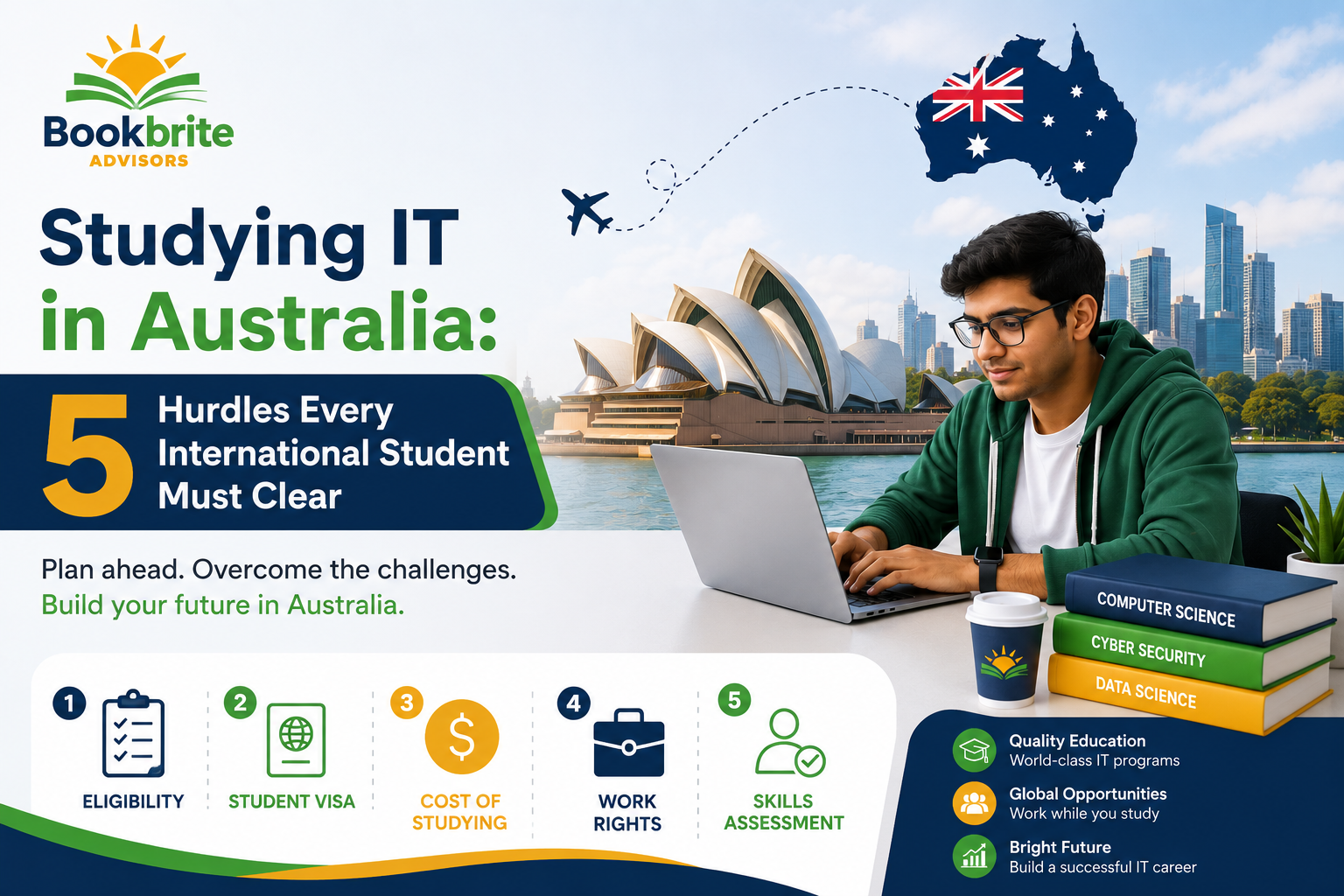
Studying IT in Australia: 5 Hurdles Every International Student Must Clear
Most international students spend weeks obsessing over university rankings. They compare campuses, scroll through course pages, and agonise over their personal statement.
Then they get their offer letter — and assume the hard part is over.
It isn't. Not even close.
The truth is, getting into an Australian IT degree is often the easiest step. What actually determines whether your Australian adventure becomes a thriving tech career — or a stressful last-minute scramble to the airport — happens almost entirely after you've accepted that offer.
There's a four-letter acronym almost no one researches until it's too late. A visa rule that can quietly disqualify you if you misjudge one number. And a financial threshold that rises every single year.
By the end of this guide, you'll know all three — and everything else you need to plan your Australian IT degree with your eyes wide open.
Why IT? Why Australia?
Australia has spent the last decade actively recruiting tech talent. Software developers, cybersecurity specialists, data scientists, and network engineers regularly appear on the country's official skills-shortage lists — which means the government has a direct incentive to keep training pathways open for international graduates who want to stay.
That's genuinely unusual. Most countries don't make it this easy to connect a degree to a long-term career and eventually, a permanent home.
But "easy" is relative. To actually benefit from this pipeline, you need to clear five hurdles — in order. Miss any one of them and the whole plan stalls.
Let's go through each one, starting with the question nobody thinks to ask first.
Hurdle 1: Are You Actually Eligible?
Before you think about visas, flights, or bank statements, an Australian institution has to accept you. Requirements vary by course level, but here's the general shape.
For a Bachelor's degree in IT or Computer Science:
- Completion of senior secondary school (Year 12 equivalent), with solid marks in mathematics — most IT programs want evidence you can handle logical and quantitative thinking
- English proficiency: universities set their own bar, which is usually higher than the visa minimum — typically an IELTS overall score between 6.0 and 6.5 (often 6.5–7.0 for a master's), though PTE Academic, TOEFL iBT, and Cambridge English are also widely accepted
- If your grades or English fall short, pathway programs — foundation courses, diplomas — exist specifically to bridge you into a full degree
For a Master's degree in IT (the more popular route for career-changers):
- A relevant bachelor's degree, though many Australian universities accept graduates from unrelated fields into conversion master's programs designed exactly for this
- English requirements are similar to or slightly higher than undergraduate entry
- Some specialisations — cybersecurity, data science, AI — may want a stronger quantitative background
Here's the detail that trips up more people than you'd expect: meeting the university's requirements doesn't automatically mean you meet the visa's requirements. They're assessed separately. And the visa requirement is the one that decides whether you actually board the plane.
Speaking of which…
Hurdle 2: The Student Visa — and the Rule That Catches People Off Guard
Nearly every international student studying in Australia needs the Student visa, Subclass 500. It's the gateway document, and it has a few moving parts worth knowing in detail — all current as of mid-2026.
The Genuine Student Requirement
Australia recently replaced its old "Genuine Temporary Entrant" test with something called the Genuine Student (GS) requirement. In practice, this means answering a short set of questions — usually capped at around 150 words each — about why you chose this course, this institution, and what your plans look like after graduation.
It sounds simple. But vague or generic answers are one of the most common reasons applications stall. Officers are looking for a coherent story, not a template.
Financial Capacity
You must prove you can support yourself without depending entirely on part-time work. As of 2026, the benchmark living-cost figure is AUD 29,710 per year for a single applicant — on top of your first year's tuition and a travel allowance. If you're bringing a partner or children, additional amounts apply per person.
This figure is reviewed and typically increased annually. Always check the current number before you start preparing bank statements.
The English Language Rule Nobody Explains Properly
Here's where most guides get it wrong — because two different bodies set two different minimum scores.
Your university sets the bar for course entry (that 6.0–7.0 range above). But separately, the Department of Home Affairs sets its own minimum for the visa itself:
Scenario IELTS Minimum Direct entry to a degree 6.0 overall, no band below 5.0 Foundation or pathway programs 5.5 overall ELICOS (English prep) packaged with your course 5.0 overall Citizens of UK, USA, Canada, NZ, Ireland Generally exempt Since the university's requirement is usually the higher of the two numbers, it's normally what you're studying toward. But knowing the visa has its own separate floor matters — especially if a pathway course puts the numbers in a different order for you.
One more thing: only test results from an in-person, secure test centre count for visa purposes. At-home or fully online versions aren't accepted.
Other Requirements to Budget For
- Overseas Student Health Cover (OSHC): Mandatory health insurance for the full length of your visa — roughly AUD 600–1,000 per year, depending on provider and family situation
- Confirmation of Enrolment (CoE): You can't apply for the visa without this — it's issued by your institution once you've accepted your offer and paid a deposit
- Visa application fee: Currently AUD 2,000 for the main applicant — a cost that's risen sharply in recent years, so treat it as a real line item
Processing times vary widely — anywhere from a couple of weeks to several months — depending on your country and how complete your application is. Apply early.
Hurdle 3: What Will It Actually Cost?
This is where the daydream meets the spreadsheet. Here's what tuition typically looks like per year:
Course Level Typical Annual Tuition (AUD) Bachelor's degree 20,000 – 50,000 Master's degree 22,000 – 50,000 Vocational / Diploma (TAFE) 6,000 – 22,000 Prestigious Group of Eight universities and big-city campuses (Sydney, Melbourne) sit at the higher end. Regional universities are often noticeably cheaper while still offering CRICOS-registered, government-recognised qualifications.
Beyond tuition, your realistic budget needs to include:
- Living costs: AUD 29,710/year — use the Department of Home Affairs figure, not a generic cost-of-living calculator, since it's the number a visa officer will actually check against
- OSHC: AUD 600–1,000/year
- Student visa fee (Subclass 500): AUD 2,000 (once, upfront)
- Post-study visa fee (Subclass 485): AUD 4,600 (once, after graduation) — budget for this now, not later
- One-off setup costs: Flights, initial accommodation deposits, textbooks
The good news? Australia's part-time work rights — covered next — let you offset a meaningful chunk of your living expenses. Though tuition itself is rarely something work income alone can cover.
Hurdle 4: Working While You Study — What You're Actually Allowed to Do
International students on the Subclass 500 visa can work up to 48 hours per fortnight while their course is in session, with no cap during scheduled course breaks. If you're doing a Master's by Research or a PhD, the cap disappears entirely once your research has begun.
One practical nuance many students miss: you can't legally start working until your course itself has started. Arriving a few weeks early doesn't buy you extra income-earning time.
With Australia's national minimum wage rising to AUD 26.44 per hour from 1 July 2026 (up from AUD 24.95), those 48 hours are genuinely useful for covering groceries, transport, and rent — even if they won't touch the tuition bill much.
Hurdle 5: The One Nobody Warns You About
Here it is. The hurdle that catches the most people off guard, usually in their final semester when it's far too late to do anything about it.
If your goal is to actually work in IT in Australia long-term — not just study and leave — there is a gatekeeper standing between your degree and a skilled visa.
That gatekeeper is the Australian Computer Society (ACS).
What Is ACS and Why Does It Matter?
ACS is the government-approved body that evaluates whether your IT qualifications and work experience genuinely meet Australian professional standards for skilled migration. Without a positive ACS skills assessment, you cannot lodge an Expression of Interest for most points-tested skilled visas. You can't be nominated for the more advanced post-study pathways. Your degree, on its own, is not enough.
Here's how the assessment actually works — and where people go wrong.
Step 1: Choose your ANZSCO occupation code. You nominate an occupation from Australia's official classification system — software engineer, systems analyst, network administrator, and so on. Choosing the wrong occupation code relative to your actual study and work background is one of the single biggest reasons assessments come back negative. This step deserves real thought, not a guess.
Step 2: ACS audits your degree's ICT content. Your qualification is reviewed subject by subject to determine whether it counts as an "ICT major," an "ICT minor," or has "insufficient" technical content for your nominated role. The proportion of genuinely IT-focused subjects matters more than what your degree is called.
Step 3: ACS checks your work experience against the SFIA framework. If your previous work involved a non-ICT degree, ACS will typically deduct a couple of years of "settling in" time before counting the rest as professionally relevant.
No formal IT qualification? There's still a route — called Recognition of Prior Learning — but it demands significantly more years of documented, relevant experience plus detailed project reports.
Recent graduates of Australian institutions get a simplified pathway built around the Temporary Graduate visa. It's faster, but only useful for that particular visa — not for permanent migration points.
The takeaway here is simple: don't wait until your final semester to think about this. The occupation you eventually nominate for ACS should be something you've been quietly building evidence for — relevant subjects, a related thesis topic, an internship in that exact area — well before you graduate.
After Graduation: What Comes Next?
Once you finish your degree, most students transition to the Temporary Graduate visa (Subclass 485), which lets you live and work in Australia without the 48-hour cap.
Before you get there, though, there are three things about this visa that have caught many recent graduates completely off guard — and that you should budget and plan for from day one.
The fee is now AUD 4,600. As of 1 March 2026, the application charge for the Subclass 485 jumped from AUD 2,300 to AUD 4,600 for the primary applicant — an increase announced without warning. This makes it one of the most expensive post-study work visas in the world. Build this into your financial plan before you even start your degree, not after.
You must be under 35 when you apply. Since July 2024, the general age cap for most 485 streams dropped from 50 to 35. If you're older than 35 at the time of lodgement, most standard post-study pathways are closed to you. There are limited exceptions for certain passport holders, but for the vast majority of applicants, this is a hard cutoff.
The English bar is higher than for your student visa. To be granted a 485, you now need a minimum IELTS score of 6.5 — higher than the 6.0 required for the Subclass 500 student visa. Your test result is also only valid for one year, so timing your English test close to graduation matters.
How long the 485 lasts depends on your qualification level — bachelor's and coursework master's graduates typically receive 2 years, research master's and PhD graduates generally receive up to 3 years, with regional study bonuses on top. Because these settings continue to change, always confirm current figures with the Department of Home Affairs before relying on them.
From there, a positive ACS assessment becomes your ticket to apply for points-tested skilled visas or employer-sponsored pathways — the routes that can eventually lead to permanent residency.
So, Where Does That Leave You?
Strip away the acronyms, and studying IT in Australia really comes down to four questions — answered in order:
- Do I meet the academic and English bar for the course I want?
- Can I genuinely satisfy the visa's financial and Genuine Student requirements — not just on paper, but with documentation that tells a consistent, believable story?
- Have I budgeted realistically for tuition, living costs, the student visa fee, and the AUD 4,600 post-study visa — not just the headline tuition number?
- Have I planned my occupation and ACS pathway early — not discovered it exists in my final semester?
Most students nail question one and stumble on question four. Simply because nobody mentioned it until it was too late.
Now you know where the real hurdle sits. Build your entire study plan with it in mind from day one — and you'll be miles ahead of almost everyone else arriving on the same flight.
Official Sources to Bookmark (These Don't Go Stale)
Blog posts go stale. Government agencies don't — or at least, they update their own pages when the rules change. Before you make any decision involving money, timelines, or migration, cross-check against these:
- Student visa (Subclass 500) — eligibility, fees, work rights: immi.homeaffairs.gov.au
- Study Australia — government student portal, visa guides, course search: studyaustralia.gov.au
- English language visa requirements — accepted tests and current minimums: immi.homeaffairs.gov.au/help-support/meeting-our-requirements/english-language
- Temporary Graduate visa (Subclass 485) — post-study work rights: immi.homeaffairs.gov.au
- ACS Migration Skills Assessment — pathways, checklists, occupation lists: acs.org.au/msa
- Fair Work Ombudsman — current minimum wage and pay rates: fairwork.gov.au
Visa fees, financial thresholds, work-hour limits, and post-study visa durations are reviewed regularly and have changed multiple times in recent years. Always verify current figures using the links above before making any decisions based on this guide.